

The philosophy behind Free and Open Source Software — commonly abbreviated as FOSS — is rooted in a deceptively simple idea: that software is a form of knowledge, and that knowledge belongs to everyone. This conviction was articulated most forcefully by Richard Stallman, who launched the GNU Project in 1983 and later formalized his thinking in the GNU General Public License, a legal instrument designed to ensure that software released under its terms would remain permanently free — not in the sense of price, but in the sense of freedom. Stallman identified four essential freedoms that every user deserves: the freedom to run a program for any purpose, the freedom to study how it works, the freedom to redistribute copies, and the freedom to distribute modified versions so that the whole community benefits from improvements. These four freedoms are not technical specifications — they are a moral framework, a declaration that the relationship between a user and their software should be one of transparency and empowerment rather than dependency and control. At a time when software companies were beginning to treat their code as proprietary secrets to be licensed rather than shared, this position was genuinely radical, and its influence on the subsequent history of computing cannot be overstated.
The philosophy behind Free Open Source Software (FOSS) emphasizes collaboration, transparency, and community-driven innovation, allowing anyone to view, modify, and distribute the source code. This approach fosters an environment of shared knowledge and continuous improvement, benefiting both developers and users alike.
The open source movement that grew alongside and sometimes in tension with Stallman’s free software philosophy brought a different but complementary emphasis to the table — one focused less on the ethics of software freedom and more on the practical superiority of open development as an engineering model. Linus Torvalds, releasing the Linux kernel in 1991 with an invitation for anyone to contribute, demonstrated what was then a controversial proposition: that a loosely coordinated global community of volunteer programmers could produce software of equal or greater quality than teams of paid engineers working behind closed doors. Eric S. Raymond articulated this phenomenon in his landmark 1997 essay The Cathedral and the Bazaar, contrasting the traditional closed development model with the chaotic, distributed, and extraordinarily effective model that open source projects had pioneered. The insight at the heart of that essay — that given enough eyeballs, all bugs are shallow — has proven itself repeatedly across decades of open source development, and explains why the most security-critical infrastructure on the internet runs overwhelmingly on software whose source code any researcher in the world can read and audit. The practical and the philosophical arguments for open source ultimately converge on the same conclusion: transparency produces better outcomes, in software as in most other human endeavors.
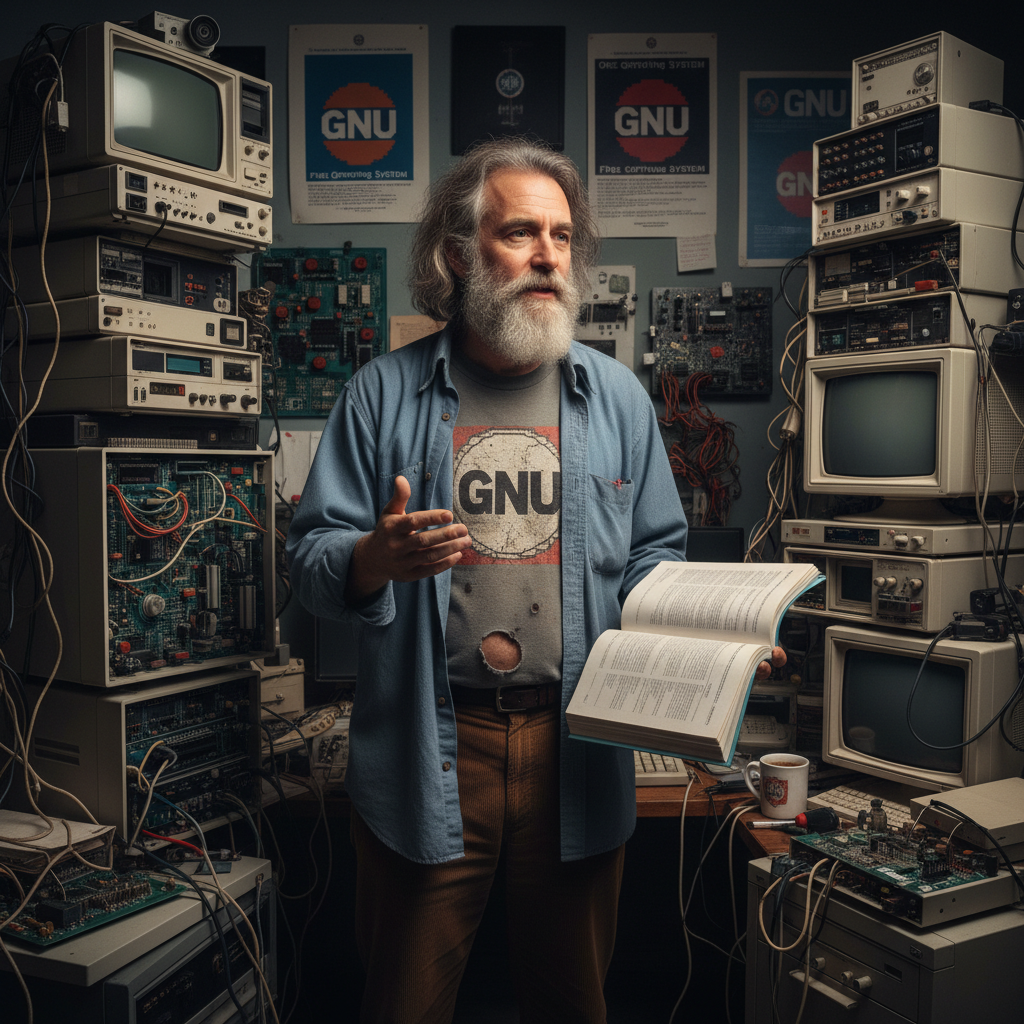

What makes the FOSS philosophy genuinely profound rather than merely practical is the way it encodes a particular vision of what the relationship between human beings and technology ought to look like. Proprietary software, by its nature, creates a power asymmetry — the developer knows exactly what the software does, and the user must simply trust that it does what they are told. Open source inverts this relationship, or at least makes it voluntary, by ensuring that anyone with the curiosity and the skill can verify the behavior of the tools they depend on. This matters most urgently in the domain of privacy and security, where the consequences of misplaced trust can be severe, but it carries a broader cultural significance as well. A society whose critical infrastructure — its communications, its financial systems, its medical records, its democratic processes — runs on software that only a handful of companies can inspect is a society that has quietly surrendered a meaningful dimension of its sovereignty. The FOSS movement represents a persistent, principled refusal to accept that surrender as inevitable, and the remarkable fact that so much of the modern internet runs on Linux, Apache, PostgreSQL, Python, and other open source foundations suggests that refusal has been vindicated by history.
conclusive thoughts on Linux Philosophy
The philosophy of Free and Open Source Software is, at its deepest level, an argument about what kind of world we want to build with our most powerful tools. It insists that the digital infrastructure of modern life should be a commons — owned by no one, available to everyone, and improved through the contributions of all who are able — rather than a collection of privately held territories that users must pay to enter and are forbidden to understand. This is not a naive or utopian position; it is one that has been tested against the full force of commercial software development for more than four decades and has not only survived but quietly prevailed in the most consequential arenas. Every time you browse a website, send a message, or use a smartphone, you are almost certainly depending on FOSS software somewhere in the chain, usually in several places at once. The movement asks something of its beneficiaries in return — not money, but participation, in whatever form you are able to offer: writing code, filing bug reports, translating documentation, teaching newcomers, or simply choosing open tools over closed ones when the choice is available to you. In honoring that ask, even imperfectly and incrementally, each of us becomes part of a tradition of collaborative knowledge-building that is among the finest things the computing age has produced.
Leave a Reply